It’s Monday morning. A sales executive is running twenty live opportunities. Quarter-end is two weeks away. They have a daily schedule, a pipeline, customer notes in different places, and a long list of follow-ups.
Same morning, two architectures
They ask a follow-up: “For the top three, enrich the customer profiles. Pull the latest from LinkedIn, recent press, and the last email thread, and suggest an outreach angle for each.” The assistant assembles the picture from each source and proposes three tailored approaches.
They ask one more: “My ten o’clock got moved to Thursday and I want to block ninety minutes for the proposal on the Acme deal. Update my schedule.” The schedule updates.
Every company we work with is asking how to get here. They have seen what AI can do for individuals. How do they make it work for the whole business?
Most suggestions fail to provide answers. “Buy this copilot” is a product pitch. “Become AI-native” is a slogan. Neither tells a leader what to build, what to buy, or who in the organisation gets access.
There is a clearer way to think about it.
The architecture that already runs your business
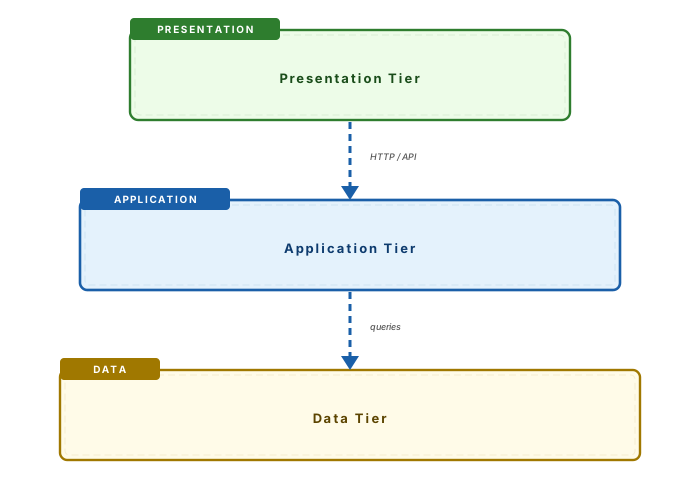
For the last three decades, enterprise software has been built on a three-tier architecture: presentation, application, data. A web or mobile interface at the top. A middle tier of application logic, exposed through web services. A database underneath. Three boxes, arrows between them, clear separation of concerns.
It ran the dotcom era, the move to service-oriented architecture and microservices, and underpins every SaaS platform your company uses today. It survived because it scales, it supports a strong security model, and it separates responsibilities cleanly. Each tier evolves independently of the others. Teams own different tiers without stepping on each other. New technology lands in one tier without forcing a rewrite of the other two.
The new three tiers
AI has not killed this architecture, it has reshaped it.
The new presentation tier: AI assistant and Skills
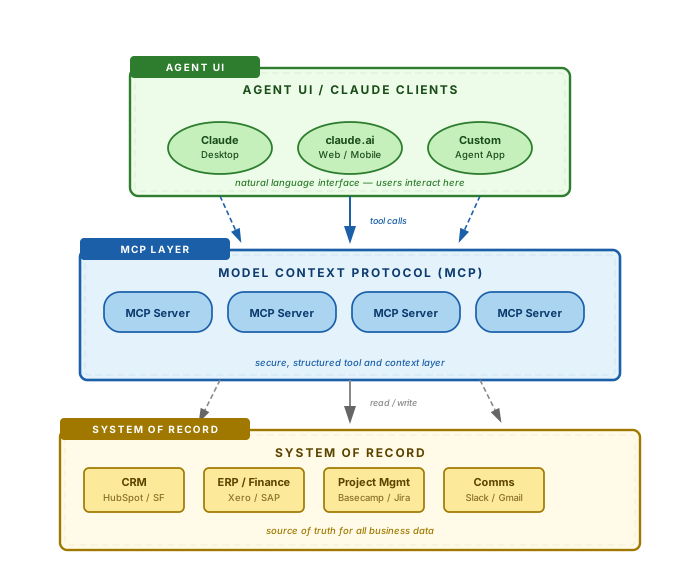
A Skill is an instruction set that teaches an AI assistant, like Claude Desktop, ChatGPT, or Copilot, how to complete a workflow. Its the perfect place to add your specific business logic and assumptions, for example “Log a sales opportunity into the pipeline” maps to a set of instructions that precisely describe the format of the opportunity, what chance of closing it has and what the next steps are.
The user does not navigate to a screen, they ask. The Skill does the work inside the assistant they already use.
The deeper shift is that this new presentation tier is malleable in ways the old one never was. A traditional UI gives you the paths a product manager scoped two years ago. Every screen, every filter, every export button, every report is a decision someone made in advance about what users would want. If your question does not fit one of those paths, you cannot ask it. You file a feature request and wait six months.
An AI assistant has no such ceiling. You can combine data in permutations no developer envisaged. “Cross-reference last quarter’s deals with the Slack threads where we discussed them, and tell me which ones had the most internal disagreement before close.” No product manager scoped that screen. No developer built that report. The assistant assembles it on demand. Tomorrow you ask a different question. The day after, a different one again. The interface bends to the question, not the other way round.
This is the move that opens AI usage to the whole organisation. A traditional UI requires the user to learn the application. A Skill adapts to the user. Someone in finance, someone in sales, and someone in operations can all invoke the same underlying systems through different Skills without sharing a screen layout.
The new application tier: MCP
MCP, the Model Context Protocol, is the new middle tier. It is a single open standard for how AI assistants talk to systems, originally published by Anthropic in late 2024 and donated to the Linux Foundation as critical infrastructure in December 2025. Instead of writing a custom integration for every tool, you write an MCP server once and any AI assistant can use it.
A reasonable engineer will ask: why not just call command-line tools? Because a CLI assumes a human in a terminal with the binary installed, and the moment you require that, you have restricted AI usage to the technical staff in your organisation.
CTO primer
The next three paragraphs will equip you for a conversation with your CTO. MCP is the protocol layer that lets AI usage scale beyond the individual. Three things it brings that are important:
- Authentication with role-based access. MCP runs auth at the protocol layer, not buried in each tool. The server knows who is asking. Finance gets the finance tools. Sales gets the sales tools. The same server safely serves both, without exposing one team’s data to the other.
- A wrapper for legacy APIs. Most enterprise systems already have an API. They were not designed for AI clients. An MCP server sits in front of those APIs and translates: turning REST endpoints, SOAP calls, even database queries into something an AI assistant can use natively. You do not have to rewrite the legacy system. You wrap it.
- Caching and rate limiting. Without these, the first sales rep to ask “summarise this quarter’s deals” hits Salesforce. The next ten do too. With caching at the MCP layer, the underlying system gets called once. The other nine requests get served instantly and the rate limits stay intact.
Built well, MCP servers run inside the AI assistant’s existing sandbox and use its native security model, so the whole organisation can use them safely without new infrastructure or custom installs.
The new data tier: the durable software underneath
The data tier has been promoted. When the presentation tier becomes interchangeable and the application tier becomes a protocol, the durable thing left underneath is the software where your truth lives. Salesforce for sales. Workday for HR. Your finance system. Your data warehouse. Your ticketing system. What people in IT call “systems of record”.
Owning clean systems of record is a strategic asset in an AI-centric world. Aaron Levie, CEO of Box, put this most clearly:
Systems of record become more important with AI agents, not less. When you have a hundred times more agents than humans, you care more about the workflows and data those agents are tied to, not less.
What this means for scaling AI across your organisation
Three implications for any leader trying to take AI from individual experiments to organisation-wide usage.
On the presentation tier: invest in Skills, not interfaces. Stop briefing teams to build new internal dashboards. Brief them to build Skills that work inside the AI tools your people already have. The same Skill works for finance, sales, and operations because it adapts to the user. The same Skill scales from ten people to a thousand because it has no UI to maintain.
On the application tier: standardise on MCP. Your future integration layer is not custom middleware. It is MCP servers. Build them once. Run them in the desktop sandbox. Let any AI assistant in the company use them. This is how the integration layer stops being a per-team cost.
On the data tier: own the software your truth lives in. Audit it. Understand which systems are durable assets and which are weak APIs waiting to be replaced. The ones with strong MCP support and clean data are about to become the most valuable software in your company. The ones without are about to become liabilities.
Conclusion
The three-tier architecture has not been replaced, it has been reshaped. Organisations that recognise this early get to define their tech stack, how the business can use it, and how quickly it scales.
You should be asking the questions: How do we get AI past the early adopters and make it work for the whole business? How do we build something that scales without becoming a maintenance burden?
Future Workshops is a digital product studio. We build AI products and Skills that scale across organisations.
Book a 30-minute call. We’ll walk through where AI is already working in your business and where the gaps are.